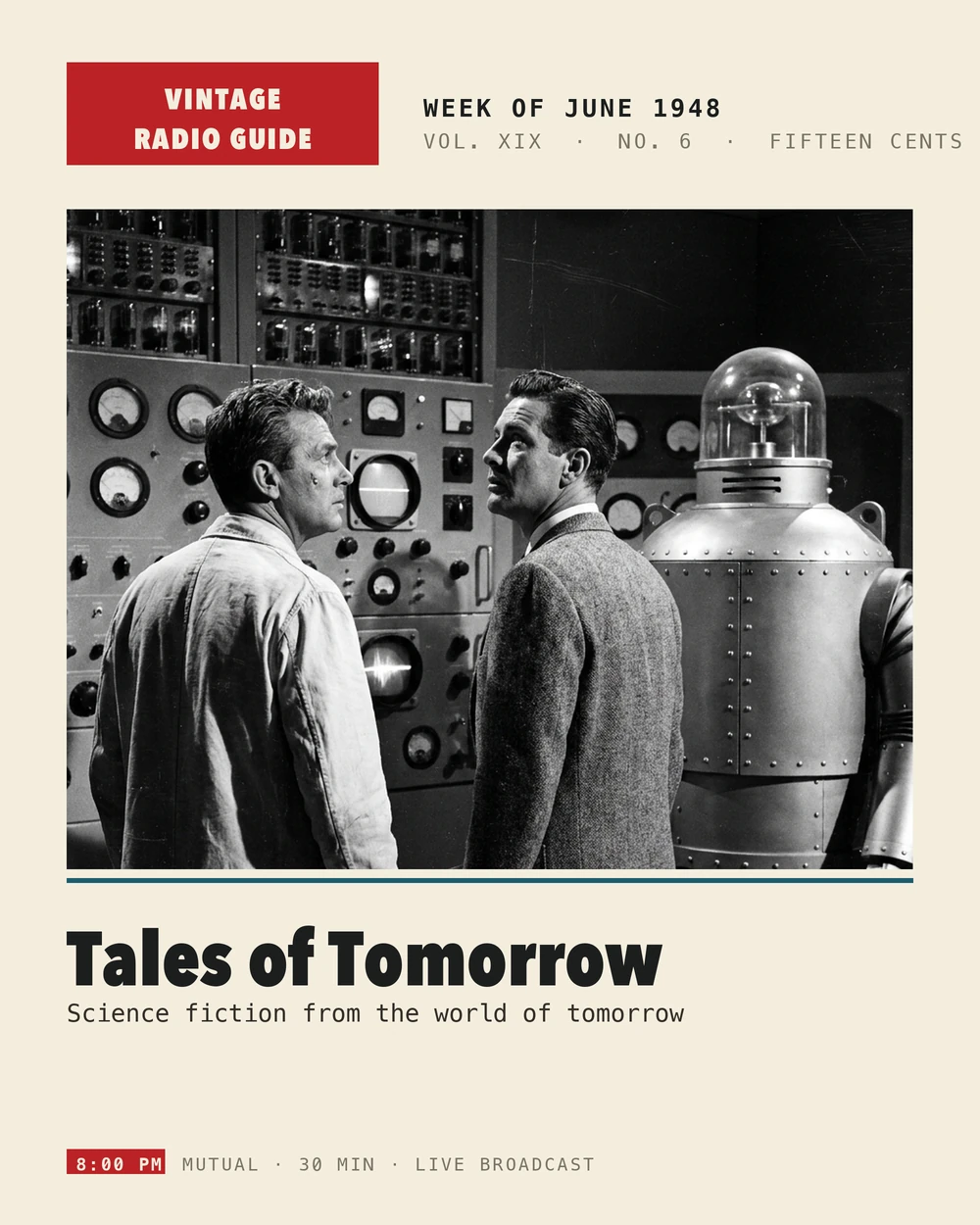
Tales of Tomorrow
A Show That Crossed Two Networks in Fifteen Weeks
Tales of Tomorrow had the unusual distinction of airing on two competing networks within a single run of just fifteen episodes. It launched on ABC on January 1, 1953, jumped to CBS on February 26, and finished there on April 9 of the same year. Every episode aired on Thursdays at nine o'clock, ran exactly thirty minutes, and the whole enterprise was done in just over three months. Short-lived does not begin to cover it.
The show was a companion production to the Tales of Tomorrow television anthology, which ABC had been broadcasting live since August 3, 1951. That television version, produced under the George F. Foley Productions banner, had been developed by science fiction author Theodore Sturgeon and producer Mort Abrahams under the original working title Tomorrow Is Yours. George F. Foley Jr. produced both the television series and the radio adaptation. The radio version was directed by Clark Andrews and Warren Sommerville, with scripts adapted by Michael Sklar and Don Witty drawing exclusively from Galaxy Science Fiction magazine. The television version had pulled from a much wider pool — a catalog of two thousand short stories and thirteen novels — but the radio series anchored itself entirely to Galaxy.
Raymond Edward Johnson and the Omentor Character
The single most recognizable element of the radio series was its host. Raymond Edward Johnson took on the character of "Omentor," a traveler from the distant future, and framed each story from that vantage point. The announcer's tagline set the tone each week: "Tales of Tomorrow! Tales beyond human imagination... until they happen."
Johnson was already well known to radio audiences from his years hosting Inner Sanctum Mysteries on NBC-Blue and CBS from 1941 to 1945, where he played the silky, pun-loving "Raymond." He had left Inner Sanctum to join the Army and been replaced successively by Berry Kroeger and Paul McGrath. His other radio work included Mandrake on Mandrake the Magician for Mutual (1940–1942) and Commander Don Winslow on Don Winslow of the Navy for NBC-Blue (1942–1943). Born in Kenosha, Wisconsin, on July 24, 1911, he had worked as a bank teller before studying at the Goodman School of Drama in Chicago. Multiple sclerosis, diagnosed in his forties, progressively curtailed his career, and he died in Wallingford, Connecticut, on August 15, 2001, at age 90.
As Omentor, Johnson carried over some of the vocal mannerisms and trademark chuckle from his "Raymond" persona, but the framing was science fiction rather than horror puns. The musical underscoring reinforced the difference: where Inner Sanctum had relied on a Hammond organ, Tales of Tomorrow built its sound around a muted trumpet beneath the narration and a xylophone striking dissonant chords — described by one reviewer as a "jazzy cacophony." It was a markedly different sonic identity. The supporting cast, drawn largely from the New York radio pool, included John Raby, Maurice Tarplin, and Roily Bester. One reviewer found Johnson's narration and the Galaxy source material to be the show's only genuine strong points.
What the Episodes Covered
The stories adapted for the series ranged across the territory Galaxy Science Fiction was mapping in the early 1950s. The premiere episode, "Watchbird" by Robert Sheckley (January 1, 1953), explored the concept of robotic surveillance spiraling out of control. The third episode, "Betelgeuse Bridge" by William Tenn (January 15, 1953), depicted interstellar diplomacy. "The Other Now" by Murray Leinster (January 22, 1953) dealt in parallel realities and starred Dick York, who would later become known for Thriller on television and for playing Darrin Stephens on Bewitched.
"Syndrome Johnny," broadcast February 5, 1953, depicted a future plague scenario set in 2090 AD involving Lucius McVane, head of Health Control for the Federated States of America. "The Moon Is Green" imagined a post-World War III landscape in which a woman confined to a radioactive bunker hears a voice from outside the lead shutters. "Martians Never Die" (March 12) followed an astronaut returning from Mars with a Martian pet that functions as a bodyguard. The remaining episodes included "The Girls from Earth" by Frank M. Robinson (March 19), "The Old Die Rich" by H. L. Gold (March 26), "Morrow on Mars" (April 2), and the finale, "The Drop," on April 9. On that final broadcast, Johnson signed off by thanking Galaxy Magazine and stating, "Tonight we conclude our current series of Tales of Tomorrow."
The content was in the same general territory as NBC's Dimension X, which had aired two years earlier. The parallel was structural as well: Dimension X had drawn from Astounding Science Fiction magazine in much the same way Tales of Tomorrow drew from Galaxy.
What Survived and What Didn't
Of the fifteen episodes produced, seven are known to have survived, and the sound quality of those recordings is generally poor. "The Girls from Earth" survived but with audio described as almost incomprehensible. The remaining episodes have not turned up in listenable form.
Four of the fifteen — "The Stars Are the Styx," "The Moon Is Green," "The Girls from Earth," and "The Old Die Rich" — were later adapted for X Minus One, the NBC series that debuted in 1955 as a revival of Dimension X. X Minus One adopted Galaxy Science Fiction as its source magazine, following the precedent the Tales of Tomorrow radio series had set, and ran until 1958 — a far longer run than its source of inspiration ever managed. Scripts for at least three radio episodes — "Syndrome Johnny," "Martians Never Die," and "The Drop" — have been preserved through radio research groups.
Why It Didn't Last
The show was not commercially successful. The network shift from ABC to CBS partway through a single short run suggests the production had difficulty finding stable footing, and the critical assessment at the time was mixed at best. Johnson's hosting and the Galaxy material were noted as strengths, but the program as a whole did not connect with audiences in a way that justified renewal.
The parent television series, which had been running since 1951 and totaled eighty-five half-hour episodes, ended just two months after the radio version, its final episode airing June 12, 1953. That television series has since been described as the first dedicated science fiction anthology on American television, predating The Twilight Zone by eight years. The radio version was a shorter, less ambitious companion to that larger production, and it read that way. It gave Raymond Edward Johnson a vehicle suited to his hosting strengths, sourced its scripts from one of the era's strongest science fiction magazines, and still couldn't hold an audience for a full season. Sometimes the ingredients are right and the result still doesn't work.